
$A$ source and an observer both start moving simultaneously from the origin,one along the $x-$axis and the other along the $y-$axis,with the speed of the source being twice the speed of the observer. The graph between the apparent frequency $f$ observed by the observer and time $t$ would approximately be:
- A
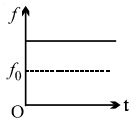
- B
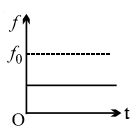
- C
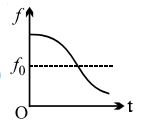
- D
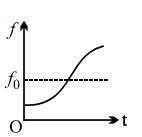
Explore More
Similar Questions
$A$ man is watching two trains,one leaving and the other coming with an equal speed of $4\,m/s$. If they sound their whistles each of frequency $240\,Hz$,the number of beats per second heard by the man will be equal to: (velocity of sound in air $= 320\,m/s$)
Difficult
View Solution$A$ source $S$ emitting sound of frequency $288 \,Hz$ is fixed on block $B$ which is attached to the free end of a spring $S_2$, and an observer $O$ is on block $A$ which is attached to the free end of spring $S_1$ as shown in the figure. The blocks $A$ and $B$ are simultaneously displaced towards each other through a distance of $0.5 \,m$ and then left to oscillate. If the angular velocity of each block is $40 \,rad/s$, then the maximum frequency observed by the observer is (speed of sound in air is $340 \,m/s$): (in $\,Hz$)
DifficultAP EAMCET 2018
View SolutionConsider the Doppler effect in two cases. In the first case,an observer moves towards a stationary source of sound with a speed of $50 \,m/s$. In the second case,the observer is at rest and the source moves towards the observer with the same speed of $50 \,m/s$. Then the frequency heard by the observer will be [velocity of sound in air $= 330 \,m/s$.]
$A$ motorcyclist is moving around a circular track of radius $50 \ m$ with a constant speed of $25 \ m/s$. $A$ static siren at point $Y$ emits sound of frequency $n$. How many times (approximately) in an hour will the motorcyclist hear the sound of the actual frequency $n$?
Medium
View SolutionTwo cars are moving on two perpendicular roads towards a crossing with uniform speeds of $72\; km/hr$ and $36\; km/hr$. If the first car blows a horn of frequency $280\; Hz$,then the frequency of the horn heard by the driver of the second car when the line joining the cars makes a $45^o$ angle with the roads will be .... $Hz$.
Difficult
View SolutionVedclass Products
For Students
Vedclass Test Series
Mock tests in real JEE/NEET style with performance analysis. 5-day free trial.
Start Free TrialFor Teachers
Exam Paper Generator
Generate Set A/B/C/D exam papers from 7.5L+ questions in 2 minutes. 3 chapters free.
Try FreeFor Institutes
Online Exam Module
Live online exams with unlimited students, 360° analytics & white-label branding.
See Demo