
The $P-V$ diagram of a certain process (Carnot cycle) is as shown. The process is also represented as:
- A
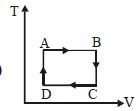
- B
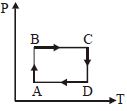
- C
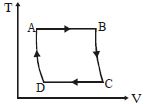
- D
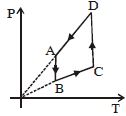
Explore More
Similar Questions
An ideal gas,initially in state $(P_{12}, V_1, T_1)$ is expanded isobarically to $(P_{12}, V_2, T_2)$,then adiabatically to $(P_{34}, V_3, T_3)$. It is then contracted isobarically to $(P_{34}, V_4, T_4)$ and finally adiabatically back to the initial state. The efficiency of this cycle is
Heat is applied to a rigid diatomic gas at constant pressure. The ratio $\Delta Q : \Delta U : \Delta W$ is
Three processes form a thermodynamic cycle as shown on the $P-V$ diagram for an ideal gas. Process $1 \rightarrow 2$ takes place at a constant temperature $(300 \ K)$. Process $2 \rightarrow 3$ takes place at a constant volume. During this process,$40 \ J$ of heat leaves the system. Process $3 \rightarrow 1$ is adiabatic and the temperature $T_3$ is $275 \ K$. The work done by the gas during the process $3 \rightarrow 1$ is ..... $J$.
One mole of a monoatomic gas and one mole of a diatomic gas are initially in the same state. Both gases are expanded isothermally and then adiabatically,such that they acquire the same final state. Choose the correct statement.
DifficultKVPY 2018
View SolutionStarting at temperature $300 \; K,$ one mole of an ideal diatomic gas $(\gamma=1.4)$ is first compressed adiabatically from volume $V_{1}$ to $V_{2}=\frac{V_{1}}{16}.$ It is then allowed to expand isobarically to volume $2V_{2}.$ If all the processes are quasi-static,then the final temperature of the gas (in $K$) is (to the nearest integer):
DifficultJEE MAIN 2020
View SolutionVedclass Products
For Students
Vedclass Test Series
Mock tests in real JEE/NEET style with performance analysis. 5-day free trial.
Start Free TrialFor Teachers
Exam Paper Generator
Generate Set A/B/C/D exam papers from 7.5L+ questions in 2 minutes. 3 chapters free.
Try FreeFor Institutes
Online Exam Module
Live online exams with unlimited students, 360° analytics & white-label branding.
See Demo