
Two long parallel wires are at a distance $2d$ apart. They carry steady equal currents flowing out of the plane of the paper,as shown. The variation of the magnetic field $B$ along the line $XX'$ is given by
- A
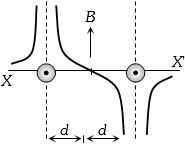
- B
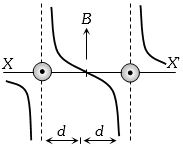
- C
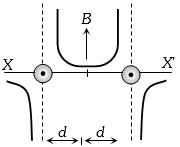
- D
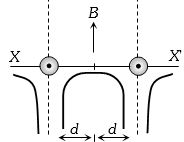
Explore More
Similar Questions
$A$ linear small part of wire $PQ$ is situated on the $y$-axis from $y = -a/2$ to $y = +a/2$, and a current $I$ is flowing through it. The magnetic field produced due to wire $PQ$ at the point $y = +a$ will be:
Medium
View SolutionAn electron moves in a circular orbit with uniform speed $v$. It produces a magnetic field $B$ at the centre of the circle. The radius of the circle is (where $\mu_{0} =$ permeability of free space,$e =$ electronic charge):
$A$ wire $A$, bent in the shape of an arc of a circle, carrying a current of $2 \, A$ and having radius $2 \, cm$, and another wire $B$, also bent in the shape of an arc of a circle, carrying a current of $3 \, A$ and having radius $4 \, cm$, are placed as shown in the figure. The ratio of the magnetic fields due to the wires $A$ and $B$ at the common centre $O$ is
DifficultJEE MAIN 2020
View Solution$A$ circular loop is kept in the vertical plane that contains the north-south direction. It carries a current that is towards the south at the topmost point. Let $A$ be a point on the axis of the circle to the east of it and $B$ be a point on this axis to the west of it. The magnetic field due to the loop is:
Medium
View Solution$A$ current-carrying wire in its neighborhood produces:
Easy
View SolutionVedclass Products
For Students
Vedclass Test Series
Mock tests in real JEE/NEET style with performance analysis. 5-day free trial.
Start Free TrialFor Teachers
Exam Paper Generator
Generate Set A/B/C/D exam papers from 7.5L+ questions in 2 minutes. 3 chapters free.
Try FreeFor Institutes
Online Exam Module
Live online exams with unlimited students, 360° analytics & white-label branding.
See Demo