
Two very long straight parallel wires,parallel to the $y-$axis,carry currents $4I$ and $I$ along the $+y$ direction and $-y$ direction,respectively. The wires pass through the $x-$axis at the points $(d, 0, 0)$ and $(-d, 0, 0)$ respectively. The graph of the magnetic field $z-$component as one moves along the $x-$axis from $x=-d$ to $x=+d$ is best given by:
- A
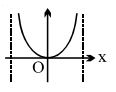
- B
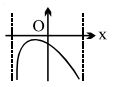
- C
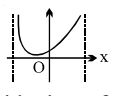
- D
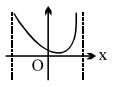
Explore More
Similar Questions
Two circular coils $X$ and $Y$,having an equal number of turns,carry equal currents in the same sense and subtend the same solid angle at point $O$. If the smaller coil $X$ is midway between $O$ and $Y$,then if we represent the magnetic induction due to the bigger coil $Y$ at $O$ as $B_Y$ and that due to the smaller coil $X$ at $O$ as $B_X$,then:
Difficult
View Solution$A$ charged particle (electron or proton) is introduced at the origin $(x=0, y=0, z=0)$ with a given initial velocity $\overrightarrow{v}$. $A$ uniform electric field $\overrightarrow{E}$ and magnetic field $\vec{B}$ are given in columns $I, II$ and $III$, respectively. The quantities $E_0, B_0$ are positive in magnitude.
Column $I$ Column $II$ Column $III$ $(I)$ Electron with $\overrightarrow{v}=2 \frac{E_0}{B_0} \hat{x}$ $(i)$ $\overrightarrow{E}=E_0 \hat{z}$ $(P)$ $\overrightarrow{B}=-B_0 \hat{x}$ $(II)$ Electron with $\overrightarrow{v}=\frac{E_0}{B_0} \hat{y}$ $(ii)$ $\overrightarrow{E}=-E_0 \hat{y}$ $(Q)$ $\overrightarrow{B}=B_0 \hat{x}$ $(III)$ Proton with $\overrightarrow{v}=0$ $(iii)$ $\overrightarrow{E}=-E_0 \hat{x}$ $(R)$ $\overrightarrow{B}=B_0 \hat{y}$ $(IV)$ Proton with $\overrightarrow{v}=2 \frac{E_0}{B_0} \hat{x}$ $(iv)$ $\overrightarrow{E}=E_0 \hat{x}$ $(S)$ $\overrightarrow{B}=B_0 \hat{z}$
$(1)$ In which case will the particle move in a straight line with constant velocity?
$(2)$ In which case will the particle describe a helical path with axis along the positive $z$ direction?
$(3)$ In which case would the particle move in a straight line along the negative direction of $y$-axis (i.e., move along $-\hat{y}$)?
| Column $I$ | Column $II$ | Column $III$ |
| $(I)$ Electron with $\overrightarrow{v}=2 \frac{E_0}{B_0} \hat{x}$ | $(i)$ $\overrightarrow{E}=E_0 \hat{z}$ | $(P)$ $\overrightarrow{B}=-B_0 \hat{x}$ |
| $(II)$ Electron with $\overrightarrow{v}=\frac{E_0}{B_0} \hat{y}$ | $(ii)$ $\overrightarrow{E}=-E_0 \hat{y}$ | $(Q)$ $\overrightarrow{B}=B_0 \hat{x}$ |
| $(III)$ Proton with $\overrightarrow{v}=0$ | $(iii)$ $\overrightarrow{E}=-E_0 \hat{x}$ | $(R)$ $\overrightarrow{B}=B_0 \hat{y}$ |
| $(IV)$ Proton with $\overrightarrow{v}=2 \frac{E_0}{B_0} \hat{x}$ | $(iv)$ $\overrightarrow{E}=E_0 \hat{x}$ | $(S)$ $\overrightarrow{B}=B_0 \hat{z}$ |
$(1)$ In which case will the particle move in a straight line with constant velocity?
$(2)$ In which case will the particle describe a helical path with axis along the positive $z$ direction?
$(3)$ In which case would the particle move in a straight line along the negative direction of $y$-axis (i.e., move along $-\hat{y}$)?
In a thin rectangular metallic strip, a constant current $I$ flows along the positive $x$-direction, as shown in the figure. The length, width, and thickness of the strip are $\ell$, $w$, and $d$, respectively. A uniform magnetic field $\vec{B}$ is applied on the strip along the positive $y$-direction. Due to this, the charge carriers experience a net deflection along the $z$-direction. This results in the accumulation of charge carriers on the surface $PQRS$ and the appearance of equal and opposite charges on the face opposite to $PQRS$. A potential difference along the $z$-direction is thus developed. Charge accumulation continues until the magnetic force is balanced by the electric force. The current is assumed to be uniformly distributed on the cross-section of the strip and carried by electrons.
$1.$ Consider two different metallic strips ($1$ and $2$) of the same material. Their lengths are the same, widths are $w_1$ and $w_2$, and thicknesses are $d_1$ and $d_2$, respectively. Two points $K$ and $M$ are symmetrically located on the opposite faces parallel to the $x$-$y$ plane (see figure). $V_1$ and $V_2$ are the potential differences between $K$ and $M$ in strips $1$ and $2$, respectively. Then, for a given current $I$ flowing through them in a given magnetic field strength $B$, the correct statement$(s)$ is(are):
$(A)$ If $w_1=w_2$ and $d_1=2d_2$, then $V_2=2V_1$
$(B)$ If $w_1=w_2$ and $d_1=2d_2$, then $V_2=V_1$
$(C)$ If $w_1=2w_2$ and $d_1=d_2$, then $V_2=2V_1$
$(D)$ If $w_1=2w_2$ and $d_1=d_2$, then $V_2=V_1$
$2.$ Consider two different metallic strips ($1$ and $2$) of same dimensions (lengths $\ell$, width $w$, and thickness $d$) with carrier densities $n_1$ and $n_2$, respectively. Strip $1$ is placed in magnetic field $B_1$ and strip $2$ is placed in magnetic field $B_2$, both along positive $y$-directions. Then $V_1$ and $V_2$ are the potential differences developed between $K$ and $M$ in strips $1$ and $2$, respectively. Assuming that the current $I$ is the same for both the strips, the correct option$(s)$ is(are):
$(A)$ If $B_1=B_2$ and $n_1=2n_2$, then $V_2=2V_1$
$(B)$ If $B_1=B_2$ and $n_1=2n_2$, then $V_2=V_1$
$(C)$ If $B_1=2B_2$ and $n_1=n_2$, then $V_2=0.5V_1$
$(D)$ If $B_1=2B_2$ and $n_1=n_2$, then $V_2=V_1$
Give the answer for question $1$ and $2$.
$1.$ Consider two different metallic strips ($1$ and $2$) of the same material. Their lengths are the same, widths are $w_1$ and $w_2$, and thicknesses are $d_1$ and $d_2$, respectively. Two points $K$ and $M$ are symmetrically located on the opposite faces parallel to the $x$-$y$ plane (see figure). $V_1$ and $V_2$ are the potential differences between $K$ and $M$ in strips $1$ and $2$, respectively. Then, for a given current $I$ flowing through them in a given magnetic field strength $B$, the correct statement$(s)$ is(are):
$(A)$ If $w_1=w_2$ and $d_1=2d_2$, then $V_2=2V_1$
$(B)$ If $w_1=w_2$ and $d_1=2d_2$, then $V_2=V_1$
$(C)$ If $w_1=2w_2$ and $d_1=d_2$, then $V_2=2V_1$
$(D)$ If $w_1=2w_2$ and $d_1=d_2$, then $V_2=V_1$
$2.$ Consider two different metallic strips ($1$ and $2$) of same dimensions (lengths $\ell$, width $w$, and thickness $d$) with carrier densities $n_1$ and $n_2$, respectively. Strip $1$ is placed in magnetic field $B_1$ and strip $2$ is placed in magnetic field $B_2$, both along positive $y$-directions. Then $V_1$ and $V_2$ are the potential differences developed between $K$ and $M$ in strips $1$ and $2$, respectively. Assuming that the current $I$ is the same for both the strips, the correct option$(s)$ is(are):
$(A)$ If $B_1=B_2$ and $n_1=2n_2$, then $V_2=2V_1$
$(B)$ If $B_1=B_2$ and $n_1=2n_2$, then $V_2=V_1$
$(C)$ If $B_1=2B_2$ and $n_1=n_2$, then $V_2=0.5V_1$
$(D)$ If $B_1=2B_2$ and $n_1=n_2$, then $V_2=V_1$
Give the answer for question $1$ and $2$.
In a Thomson mass spectrograph,the electric field and magnetic field are applied:
Easy
View Solution$A$ light charged particle is revolving in a circle of radius $r$ due to the electrostatic attraction of a static heavy particle with an opposite charge. How does the magnetic field $B$ at the centre of the circle, produced by the moving charge, depend on $r$?
MediumWBJEE 2018
View SolutionVedclass Products
For Students
Vedclass Test Series
Mock tests in real JEE/NEET style with performance analysis. 5-day free trial.
Start Free TrialFor Teachers
Exam Paper Generator
Generate Set A/B/C/D exam papers from 7.5L+ questions in 2 minutes. 3 chapters free.
Try FreeFor Institutes
Online Exam Module
Live online exams with unlimited students, 360° analytics & white-label branding.
See Demo