
Complete removal of both the axial ligands (along the $z-$ axis) from an octahedral complex leads to which of the following splitting patterns? (relative orbital energies not on scale)
- A
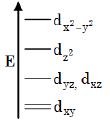
- B
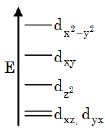
- C
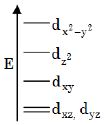
- D
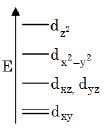
Explore More
Similar Questions
In the octahedral crystal field,the correct order of splitting for $I^{-}, H_2O, NH_3$ and $CN^{-}$ ligands is:
Draw a figure to show the splitting of $d$ orbitals in an octahedral crystal field.
The homoleptic and octahedral complex of $Co^{2+}$ and $H_2O$ has $.......$ unpaired electron$(s)$ in the $t_{2g}$ set of orbitals.
DifficultJEE MAIN 2023
View SolutionComplexes containing halide ligands are generally .....
Medium
View SolutionSimplified absorption spectra of three complexes $(i), (ii)$ and $(iii)$ of $M^{n+}$ ion are provided below; their $\lambda_{max}$ values are marked as $A, B$ and $C$ respectively. The correct match between the complexes and their $\lambda_{max}$ values is
$(i)$ $[M(NCS)_6]^{(-6+n)}$
$(ii)$ $[MF_6]^{(-6+n)}$
$(iii)$ $[M(NH_3)_6]^{n+}$
$(i)$ $[M(NCS)_6]^{(-6+n)}$
$(ii)$ $[MF_6]^{(-6+n)}$
$(iii)$ $[M(NH_3)_6]^{n+}$
DifficultJEE MAIN 2020
View SolutionVedclass Products
For Students
Vedclass Test Series
Mock tests in real JEE/NEET style with performance analysis. 5-day free trial.
Start Free TrialFor Teachers
Exam Paper Generator
Generate Set A/B/C/D exam papers from 7.5L+ questions in 2 minutes. 3 chapters free.
Try FreeFor Institutes
Online Exam Module
Live online exams with unlimited students, 360° analytics & white-label branding.
See Demo