
If the decomposition reaction $A_{(g)} \to B_{(g)}$ follows first-order kinetics,then the graph of the rate of formation $(R)$ of $B$ against time $t$ will be:
- A
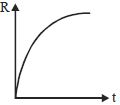
- B
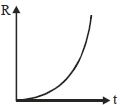
- C
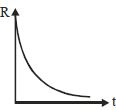
- D
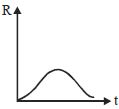
Explore More
Similar Questions
$A$ first order reaction has a rate constant of $1 \times 10^{-2} \ s^{-1}$. How much time will it take for $20 \ g$ of reactant to reduce to $5 \ g$ (in $s$)?
The reaction,$X \to$ product follows first order kinetics. In $40 \, min$ the concentration of $X$ changes from $0.1 \, M$ to $0.025 \, M$. Then the rate of reaction when concentration of $X$ is $0.01 \, M$ is:
Medium
View SolutionThe rate constant for a first order reaction is $4.606 \times 10^{-3} \ s^{-1}$. The time required to reduce $2.0 \ g$ of the reactant to $0.2 \ g$ is......... $s$
MediumNEET 2020
View SolutionConsider the two different first order reactions given below:
$A + B \rightarrow C$ (Reaction $1$)
$P \rightarrow Q$ (Reaction $2$)
The ratio of the half-life of Reaction $1$ : Reaction $2$ is $5 : 2$. If $t_1$ and $t_2$ represent the time taken to complete $2/3$ and $4/5$ of Reaction $1$ and Reaction $2$,respectively,then the value of the ratio $t_1 : t_2$ is $. . . . \times 10^{-1}$ (nearest integer).
[Given: $\log_{10}(3) = 0.477$ and $\log_{10}(5) = 0.699$]
$A + B \rightarrow C$ (Reaction $1$)
$P \rightarrow Q$ (Reaction $2$)
The ratio of the half-life of Reaction $1$ : Reaction $2$ is $5 : 2$. If $t_1$ and $t_2$ represent the time taken to complete $2/3$ and $4/5$ of Reaction $1$ and Reaction $2$,respectively,then the value of the ratio $t_1 : t_2$ is $. . . . \times 10^{-1}$ (nearest integer).
[Given: $\log_{10}(3) = 0.477$ and $\log_{10}(5) = 0.699$]
The decomposition of dinitrogen pentoxide $(N_2O_5)$ follows first order rate law. What will be the rate constant from the given data?
At $t = 800 \ s$,$[N_2O_5] = 1.45 \ mol \ L^{-1}$
At $t = 1600 \ s$,$[N_2O_5] = 0.88 \ mol \ L^{-1}$
At $t = 800 \ s$,$[N_2O_5] = 1.45 \ mol \ L^{-1}$
At $t = 1600 \ s$,$[N_2O_5] = 0.88 \ mol \ L^{-1}$
Medium
View SolutionVedclass Products
For Students
Vedclass Test Series
Mock tests in real JEE/NEET style with performance analysis. 5-day free trial.
Start Free TrialFor Teachers
Exam Paper Generator
Generate Set A/B/C/D exam papers from 7.5L+ questions in 2 minutes. 3 chapters free.
Try FreeFor Institutes
Online Exam Module
Live online exams with unlimited students, 360° analytics & white-label branding.
See Demo